On this page
- What is the Gemini Decisions API?
- What can it actually do?
- How fast and how cheap is it?
- How good is it?
- Pros
- Cons
- Who should use it, and who should skip it
- My take
- Frequently asked questions
- What is the Gemini Decisions API?
- How much does the Gemini Decisions API cost?
- Is Gemini Decision 1 better than OpenAI or Jev?
- Can the Gemini Decisions API write text?
- Who should use the Gemini Decisions API?
- Sources
Quick answer. The Gemini Decisions API is a fast, cheap Google service that scores yes/no, choice and rubric questions with a confidence number instead of writing text. It suits repetitive routing and checking jobs, but it is not the cheapest option and the benchmarks are Google's own.
What is the Gemini Decisions API?
On November 11, Google launched a new endpoint called the Gemini Decisions API, powered by a model named Gemini Decision 1. It does not write answers. You give it one input, which can mix text, images, audio, video and PDFs up to 256K tokens, plus up to 1,000 separate questions. It scores the options for each question and sends back probabilities and a confidence score from 0 to 1.
Think of it as a very fast sorting clerk. It will not draft your email, but it will tell you whether the email is a complaint, which team should get it, and how sure it is. SiliconANGLE describes the same idea: the model handles just three kinds of questions, and the trade is a much lower cost.
What can it actually do?
There are three question types. A yes/no check returns the probability that a condition holds. A choice question picks one winner from 2 to 255 options and gives a probability for each. A score question grades the input against an ordered rubric. FoneArena walks through Google's own example: one photo of a breakroom counter plus a short note, checked for a spill, matched to a cleanup action, and rated for severity, all in one request.
Google says its own teams already use it. Per FoneArena, Gemini Notebook uses it to route questions to the right model tier, with up to 40% lower latency on everyday queries, and Google Search uses it as a safety layer for MCP tools. The Decoder adds that it also does design prototyping in Stitch.
How fast and how cheap is it?
Google reports a median of 50 to 100 milliseconds of model compute and 150 to 250 milliseconds end to end, measured on inputs up to 16K tokens. The price is $0.10 per million input tokens, with zero output tokens billed. The shared input is billed once per request, however many questions you ask, and each extra question adds only its own instructions. Google says that is nearly 5 times cheaper than Gemini 3.5 Flash-Lite used through its Interactions API, $0.88 against $4.14 across seven shared evaluations. There is also a free tier in Google AI Studio for prototyping, per Interesting Engineering.
How good is it?
All the benchmark numbers come from Google, so treat them as claims until someone outside repeats them. MarkTechPost laid out Google's table. Gemini Decision 1 leads 7 of the 9 benchmarks and has the lowest calibration error, 0.0250 against 0.0494 for TypeSafe's Jev 1.14. Calibration matters more than it sounds. If a model says it is 90% sure, you want it right about 9 times in 10, because that is the number you will set your automation thresholds on.
It does not win everywhere. Jev 1.14 is ahead on When2Call, 82.0% against 79.9%, and on Mind2Web Multimodal, 86.8% against 86.2%. Its lowest result is 58.7% macro-F1 on Amazon ESCI.
Pros
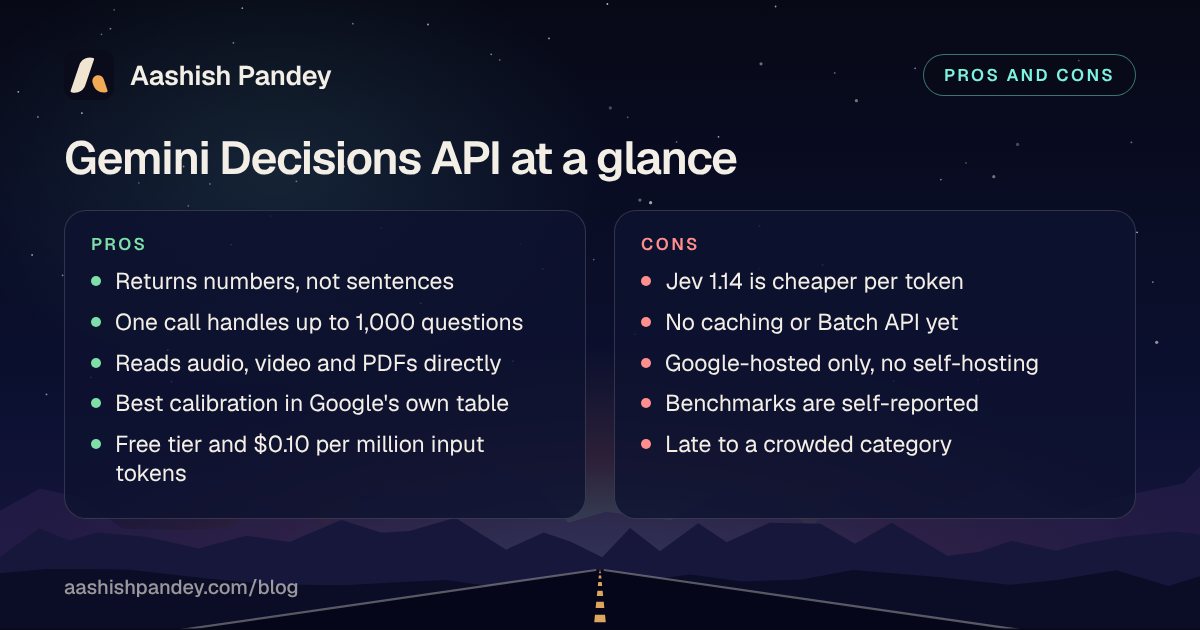
- It returns numbers, not sentences. Your code branches on a probability instead of parsing a reply like "Billing." with a full stop. An integration engineer at eesel, a company that sells a competing helpdesk product, makes the same point.
- One call, many checks. A thousand questions against one shared input, billed for the input once.
- Reads more than text. Audio, video and PDFs go in directly, with no separate transcription or OCR charge.
- Built-in doubt. The best calibration score in Google's own table, and a built-in way to send unsure cases to a person.
- Low entry cost. A free tier and a $0.10 price per million input tokens.
Cons
- Cheapest it is not. MarkTechPost reports Jev 1.14 at $0.042 per million input tokens, and $0.68 against Google's $0.88 on the shared suite.
- Missing features. eesel lists no caching, no Batch API and no text generation. Support in Google Cloud is listed as coming soon.
- Closed ecosystem. It runs only on Google's hosted API. There are no open weights and no self-hosting.
- Self-reported results. The comparisons come from Google's own table.
- Late to a crowded category. TypeSafe's Jev started the trend in mid-September and OpenAI's Decisions API followed last month, per SiliconANGLE.
Who should use it, and who should skip it
It fits teams that make the same small call thousands of times a day: routing support tickets, checking posts against a policy, grading answers, spotting damage in photos. If you run a small business with a support inbox and a developer on hand, a test costs very little.
Skip it if you want an assistant that writes or explains. It cannot. Skip it too if your data must stay on your own servers, or if you already have a decision model working and only a few cents separate the prices.
My take
I'd treat this as a useful tool for one narrow job, not a new kind of AI to rebuild around. The calibration claim is the part I'd test first, on my own data, because a confidence score is only worth something if it matches reality. For a small team I'd run it side by side with whatever sorts the work today for a week, count where the two disagree, and only then switch. And since the benchmark table is Google's own, I'd wait for independent numbers before betting a process on it.
Frequently asked questions
What is the Gemini Decisions API?
It is a Google endpoint that scores closed-set questions instead of writing text. You send one input and up to 1,000 yes/no, multiple choice or rubric questions, and it returns probabilities with a confidence score for each. Google launched it on November 11, 2026 with a model called Gemini Decision 1.
How much does the Gemini Decisions API cost?
Google charges $0.10 per million input tokens and nothing for output tokens. The shared input is billed once per request, so asking more questions adds only the tokens in each question. There is also a free tier in Google AI Studio for prototyping and testing.
Is Gemini Decision 1 better than OpenAI or Jev?
Google says it leads 7 of 9 benchmarks and has the lowest calibration error. Those figures are Google's own. Jev 1.14 beats it on two of the nine benchmarks and is cheaper, so the answer depends on your task, your budget and whether you need audio or video input.
Can the Gemini Decisions API write text?
No. It generates zero text tokens, so it cannot draft, summarise or explain anything. It is built only for bounded choices such as routing a query, checking a policy, picking a tool or grading content. Use a normal Gemini model for writing.
Who should use the Gemini Decisions API?
Teams that make the same small decision thousands of times a day will benefit most, such as ticket routing, content checks, or spotting damage in photos. If you only need an occasional answer or need a model you can host yourself, it is the wrong tool.
Sources
- Gemini Decisions API, blog.google
- Google enters decision model market with Gemini Decisions API, SiliconANGLE
- Google joins the decision-model wave with Gemini Decision 1, scoring 1,000 questions in a single pass, The Decoder
- Google introduces Gemini Decisions API for multimodal AI decisions, FoneArena
- Google Launches Gemini Decisions API With Gemini Decision 1 at $0.10/M Tokens, MarkTechPost
- Google unveils Gemini Decisions API to handle 1,000 questions at once, interestingengineering.com
- Gemini Decisions API (2026): how it works, pricing, vs OpenAI and Jev, eesel.ai
Tech news, checked twice, in your inbox.
One calm email when a story is worth your time. Unsubscribe in one click.