On this page
- What is Gemini 4 Hydrogen?
- What's new compared with Gemini 3.8 Flash?
- How does it score on benchmarks?
- How does it work in practice?
- Pros
- Cons
- Who is it for, and who should skip it?
- What does it cost, and where can I get it?
- My take
- Frequently asked questions
- What is Gemini 4 Hydrogen?
- Is Gemini 4 Hydrogen free?
- Is Gemini 4 Hydrogen better than Argon?
- How does Gemini 4 Hydrogen compare with Claude Sonnet 5.5?
- Which thinking level should I use?
- Sources
Quick answer. Gemini 4 Hydrogen is Google's fast, low-cost model, available to free Gemini app users and in Search. It edges Argon on one independent index but trails Claude Sonnet 5.5 on terminal work.
What is Gemini 4 Hydrogen?
Gemini 4 Hydrogen is Google's new fast model, released on November 12, 2026. Google's launch post pitches it for everyday coding and agentic workflows, meaning jobs where the AI carries out several steps on its own. The larger Gemini 4 Carbon and Argon models stay in charge of deep reasoning on hard problems. The Decoder calls it the counterpart to the earlier Flash series and says it is meant to replace Gemini 3.8 Flash.
It is also open to everyone from day one. SiliconANGLE reported that Argon went to vetted cybersecurity defenders first, while Hydrogen skipped that stage and anyone can use it, free Gemini app users included. You can reach it through AI Studio, the Gemini API, Gemini for business, the Gemini app and Search. Paying Google AI Pro and Ultra customers also get it inside Antigravity, Google's coding tool.
I have not tested Hydrogen myself. Everything below is what Google, the press and the independent benchmark firm Artificial Analysis report.
What's new compared with Gemini 3.8 Flash?
Speed comes first. Google says Hydrogen finishes tasks 2.5 times faster than 3.8 Flash at its default setting. On Terminal-Bench 4.1, a test of work done at a command line, it scores 57% against 18.2% for the older model. Google also says it cuts fabricated claims by more than five times and copes better when a tool call fails or a search comes back empty. Partners in early testing saw runs 2x to 2.8x faster, using 12% to 23% fewer tokens.
There are four thinking levels: low, medium, high and a new xhigh. The Decoder notes that Argon offers only medium and high. MarkTechPost adds that the default is now high rather than medium, and that the old minimal setting returns an error.
How does it score on benchmarks?
On the Artificial Analysis Intelligence Index, Google says Hydrogen scores 51 at its default high level against 50 for Argon, and 54 at xhigh. Per The Decoder, the independent firm ranks the xhigh result a point short of Claude Sonnet 5.5 and GPT-6.1 Sol, which each reach 55 when pushed to their limits.
Google lists more results. Hydrogen ranks fifth on Agent Arena, scores 58.8% on HLE-Diamond, takes first place on the Vals Tax Agent Bench at 52.3% and ties for first on the Vals Legal Research Bench at 55.8%. MarkTechPost points out that these figures are self-reported by Google unless marked otherwise, and that Terminal-Bench 4.0 and 4.1 are different versions, so scores across them are not directly comparable.
The independent numbers are more mixed. According to The Decoder, Artificial Analysis found that Hydrogen makes things up only 8 percent of the time on its AA-Omniscience test. It also found the model weaker at agentic terminal work, with 54 percent on Terminal-Bench 4.0 against 64 percent for Claude Sonnet 5.5 at its maximum setting and 56 percent for GPT-6.1 Sol.
How does it work in practice?
For developers, the headline feature is Orchestrator in Antigravity. It switches between Carbon and Hydrogen inside one session. In Google's Terminal-Bench 4.0 runs it came close to Carbon's success rate while using 24% less quota and finishing 19% faster. MarkTechPost describes the split: Carbon plans and resolves ambiguity, Hydrogen edits files and runs tests, and it hands control back when it hits friction.
For everyone else, the change shows up in Search. Google says Hydrogen is rolling out to all Search users worldwide and calls it the biggest model upgrade to Search yet. TechCrunch explains that it should handle multi-part questions, specific requests and typos better, link to a wider range of sites, and show more images, tables and comparison views in AI Mode.
In the Gemini app, Google says Hydrogen sticks more closely to your tone, format and instructions over longer conversations, and can pull context from Gmail, Drive and connected apps such as Airtable and Dropbox.
Pros
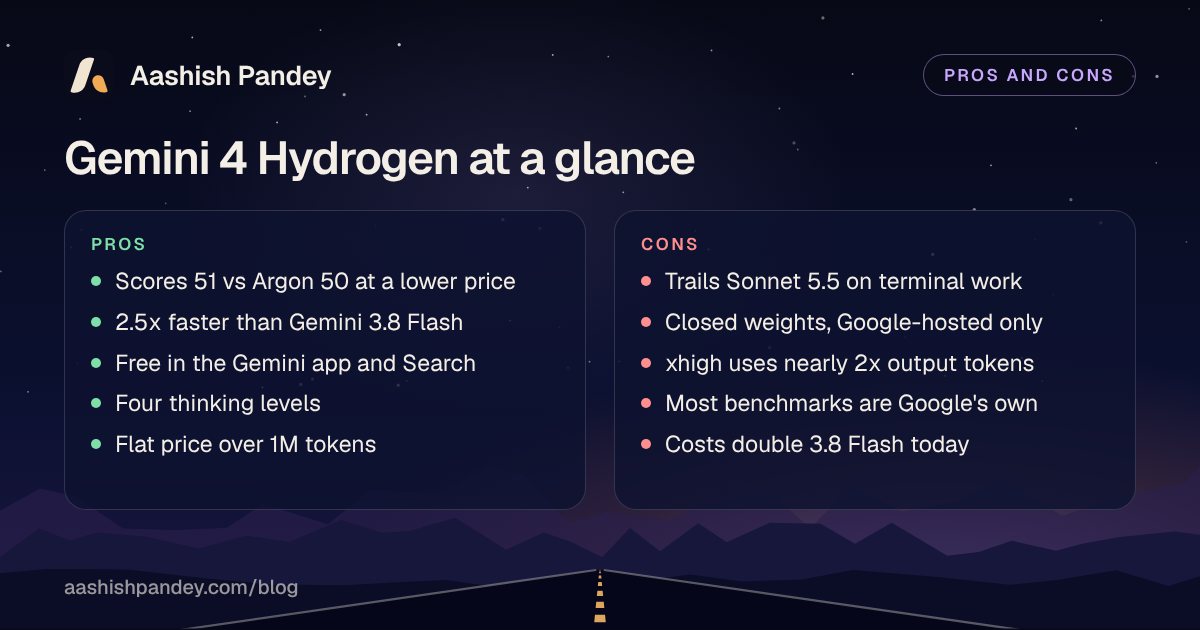
- It scores 51 on the Artificial Analysis index at its default level, one point above Argon, at a lower price.
- Google reports 2.5 times the speed of Gemini 3.8 Flash, and independent testing found it fabricates answers only 8 percent of the time on one test.
- Free Gemini app users get it through automatic model selection when Gemini judges it suits the prompt, and everyone using Google Search gets it, with no paid plan needed.
- Four thinking levels give a clear dial between cost and quality.
- Pricing is flat across the full 1 million token context window.
Cons
- It trails Claude Sonnet 5.5 on terminal work in both Google's own chart and Artificial Analysis testing, and on computer control in Google's chart.
- The weights are closed and the model runs only on Google's servers, so there is no self-hosting.
- The xhigh level needs nearly twice as many output tokens as high, which pushes the cost per task up sharply.
- Most headline benchmarks are Google's own numbers.
- Its price is double what 3.8 Flash costs today.
Who is it for, and who should skip it?
Hydrogen fits people who want quick, decent answers all day: writing and rewriting, research, document and spreadsheet work, and Search. It also fits developers running many small agent steps, where speed and cost matter more than the last few points of quality.
Skip it as your only model if your agents spend long sessions in a terminal or click around a computer, since Sonnet 5.5 leads there. Skip it too if you need open weights or self-hosting. And if you build on Vertex AI, check availability first, because MarkTechPost says the launch posts do not mention it.
What does it cost, and where can I get it?
On the API you pay $1.50 for every million input tokens and $7.50 for every million output tokens, with no surcharge as the context grows. The Decoder lists cache hits at $0.075. For comparison, SiliconANGLE reports that Argon costs $2 and $10 until November 30, then $4 and $20. MarkTechPost says Gemini 3.8 Flash costs $0.75 and $3.75 until December 31, then $1.50 and $7.50, matching Hydrogen.
Artificial Analysis measured cost per task: about $0.29 at low, $0.80 at medium, $1.87 at high and $3.16 at xhigh, per The Decoder. Quality drops fast at the bottom, with medium scoring 41 on the index and low scoring 27. At xhigh the model costs roughly a third of Claude Sonnet 5.5 at its maximum setting for nearly the same score, and about 2.5 times as much as GPT-6.1 Sol.
My take
I'd treat Hydrogen as a strong default and not as the new best model. A one point lead over Argon on one index is close to a tie, and the real news is that Argon-level scores now cost less. For everyday work and Search, I'd just use it. For a developer, I'd try it first and move up to Carbon or Sonnet 5.5 only when it gets stuck. Before you build anything big on it, I'd wait for more independent tests and for Google's own numbers to be checked by others.
Frequently asked questions
What is Gemini 4 Hydrogen?
Gemini 4 Hydrogen is Google's fast, general-purpose model, released on November 12, 2026. It is built for everyday coding, agent workflows, research and Search answers, and it replaces Gemini 3.8 Flash. Google's larger Carbon and Argon models handle the hardest reasoning, while Hydrogen focuses on quick, lower-cost execution across Google's apps and API.
Is Gemini 4 Hydrogen free?
Free Gemini app users get Hydrogen through automatic model selection when it suits the prompt, and it now powers Google Search for all users, according to Google and SiliconANGLE. Developers pay by usage on the API, at $1.50 for a million input tokens and $7.50 for a million output tokens. Antigravity access needs a paid Google AI Pro or Ultra plan.
Is Gemini 4 Hydrogen better than Argon?
On the Artificial Analysis Intelligence Index it scores 51 at its default level against 50 for Argon, and 54 at xhigh. That is a very small gap on one benchmark. Hydrogen is also cheaper, but it is weaker at agentic terminal work, so Argon or Carbon may still suit harder coding jobs.
How does Gemini 4 Hydrogen compare with Claude Sonnet 5.5?
Artificial Analysis rates Hydrogen at xhigh at 54, just behind Sonnet 5.5 at 55, at roughly a third of the cost per task. Sonnet 5.5 scores higher on terminal and computer-use tests, including 64 percent against 54 percent on Terminal-Bench 4.0. Hydrogen leads on several knowledge-work tests in Google's own chart.
Which thinking level should I use?
Hydrogen defaults to high, which Artificial Analysis scored at 51 for about $1.87 per task. Medium costs $0.80 but drops to 41, and low drops to 27. Xhigh reaches 54 but costs $3.16 per task because it uses nearly twice as many output tokens, so it makes sense only for hard problems.
Sources
- Introducing Gemini 4 Hydrogen for Agentic Workflows, blog.google
- Google Search upgrade, blog.google
- Google's latest Search upgrade promises better answers to your most complicated questions, TechCrunch
- Google's Gemini 4 Hydrogen outscores the bigger Argon just four weeks after its launch, The Decoder
- Gemini 4 Hydrogen Beats Argon and Runs 2.5x Faster, androidheadlines.com
- Google releases Gemini 4 Hydrogen, a lower-cost model said to outscore Argon, SiliconANGLE
- Google Releases Gemini 4 Hydrogen: 2.5x Faster Than Gemini 3.8 Flash, MarkTechPost
- Gemini 4 Hydrogen vs Argon vs Carbon: Which One to Use, hyperautomationlabs.co
Tech news, checked twice, in your inbox.
One calm email when a story is worth your time. Unsubscribe in one click.